WhatsApp Business on Your Website: Meet Customers Where They Are
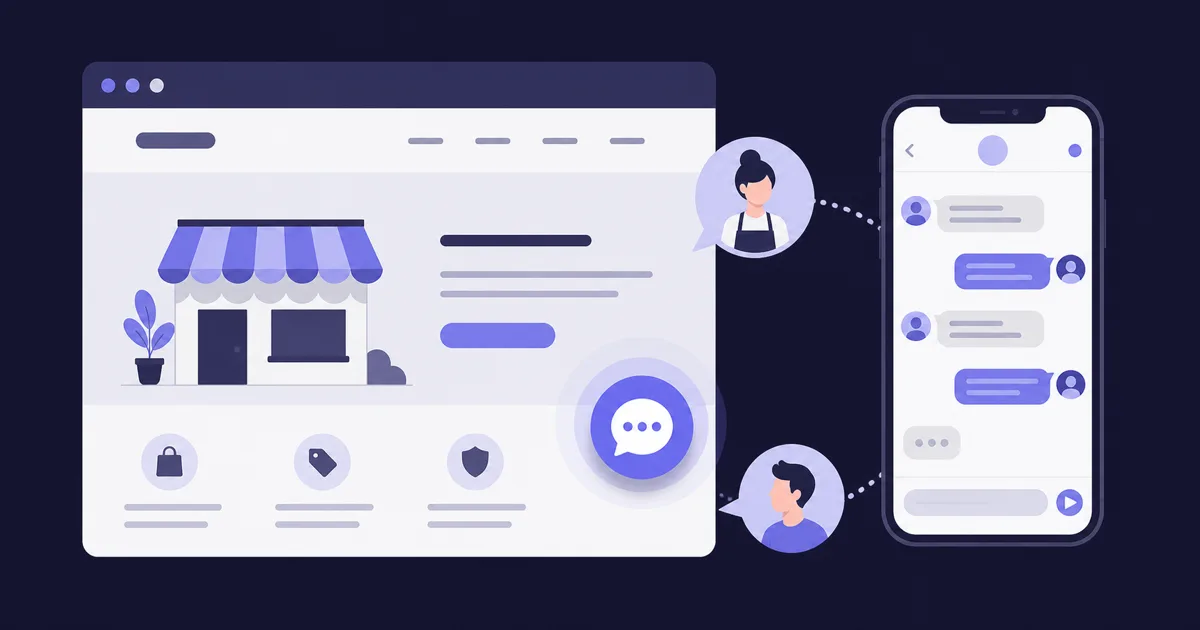
Nobody enjoys filling out contact forms, and small businesses cannot always pick up the phone. WhatsApp, on the other hand, is already in almost every customer’s hand — sending a quick message takes seconds. That is why a WhatsApp channel on the website is one of the easiest ways for small businesses to win more inquiries. This guide shows how to integrate WhatsApp Business cleanly — technically simple and without data-protection traps.
Why WhatsApp works so well as a contact channel
WhatsApp is by far the most-used smartphone app in Germany: according to the ARD/ZDF online study, around 82 percent of the population aged 14 and over use the messenger at least once a week — and even among the 70+ generation it is every second person. Your customers do not need to install anything, create an account or look up a number. One tap on the button and the message is written.
For businesses with walk-in customers or spontaneous inquiries — trades, salons, garages, restaurants — this lowers the barrier considerably. A WhatsApp message gets written from the sofa at 9 pm; a form with seven mandatory fields does not. And unlike a phone call, no inquiry is lost when nobody can pick up.
WhatsApp, Business app or API: which fits whom?
First things first: a private WhatsApp account is off-limits for company communication — the terms of service prohibit it, and it is nearly impossible to run in a privacy-compliant way. Small businesses should use the free WhatsApp Business app: it offers a company profile with address, opening hours and website link, plus quick replies, away messages, labels for sorting chats and an optional product catalogue.
The WhatsApp Business Platform (API) targets larger companies with high message volumes, team inboxes or chatbot integration — it charges per conversation and requires a technical service provider. For most businesses with up to a handful of employees, the free Business app is entirely sufficient. Handy detail: it also works with a landline number, so you do not have to publish a separate mobile number.
Getting WhatsApp onto your website: link, button, QR code
The simplest and most privacy-friendly integration is the click-to-chat link: https://wa.me/491701234567 — your number in international format without the plus sign and without the leading zero. One click opens a chat with your business directly. With an addition like ?text=Hello, I am interested in a quote you can even pre-fill a message — the customer only has to tap send.
On the website this becomes a clearly visible button — next to phone and e-mail in the contact section, or as a subtle floating chat button. The big advantage of the plain link: no Meta script is loaded until someone clicks. Your website stays fast, and no cookie banner is required for it. For print material, vehicle lettering or the counter, a QR code pointing to the same link extends the channel offline.
- Click-to-chat link: wa.me/49… — no plus sign, no leading zero
- A pre-filled message via ?text=… lowers the barrier further
- Place the button where contact decisions happen: contact page, service pages, footer
- No chat widget with Meta scripts needed — the link is enough and loads nothing upfront
- QR code for shop windows, business cards and vehicles
GDPR: the points you must get right
WhatsApp on a website is legally feasible — if you follow a few rules. First: use the Business app, not a private account. Second: mention WhatsApp communication in your privacy policy, including a note on data processing by Meta. Third — the most overlooked point: by default, the app wants access to the device’s address book. That would transfer data of customers to Meta who never consented. The clean solution: disable contact access or use a separate device for WhatsApp Business only, with no customer contacts stored on it.
Fourth: someone who sends an inquiry consents to having that inquiry answered — nothing more. Promotional messages, offer broadcasts or a WhatsApp newsletter require explicit, documented consent; otherwise you risk cease-and-desist letters under German unfair-competition law. And since January 2026 the EU Commission classifies WhatsApp as a social medium under the Digital Services Act — one more reason to run the channel professionally.
Response times and processes: keeping the channel from backfiring
WhatsApp creates an expectation: fast replies. Putting the button on your website and then letting messages sit for two days annoys prospects more than having no chat at all. The good news: the Business app ships the tools you need. A greeting message confirms receipt, an away message manages expectations outside business hours, and quick replies handle the recurring questions — opening hours, prices, directions — in seconds.
Define internally who owns the channel and within which time window replies go out. A realistic promise like “replies within 2 hours on weekdays” beats a broken “we are always there for you”. From our experience with client websites: whoever answers an inquiry within the first hour wins the job far more often than the competitor who replies the next day.
When WhatsApp is not the right channel
As low-threshold as the messenger is — some content does not belong there. Health data, legal questions, financial documents: medical practices, law firms or tax advisors should rely on secure alternatives for confidential content and use WhatsApp at most for scheduling. Binding transactions such as contract changes or cancellations are also poorly placed in a chat — proper documentation is missing.
WhatsApp also does not replace e-mail or phone; it complements them. The rule of thumb: offer the channel your customers prefer — and route every inquiry, wherever it comes from, into the same internal process. In our website subscriptions we integrate WhatsApp buttons as a privacy-friendly click-to-chat link by default, aligned with the contact page and conversion elements — no extra scripts, no cookie-banner obligation.
Frequently asked questions
May I use my private WhatsApp account for company communication?
+Do I need a cookie banner if WhatsApp is integrated on my website?
+Is WhatsApp Business GDPR-compliant?
+What does WhatsApp Business cost?
+May I send customers offers and newsletters via WhatsApp?
+Website subscription — from €79/month
Custom web design, German hosting, maintenance and personal support in one monthly package.
Book a free consultation